 Health
  Find a
  Book an
 Bile Duct Tumors
Cholangiocarcinoma refers to a tumor involving the bile duct. Patients with this disease present with jaundice, itching, and pale coloured stools. Early diagnosis of this tumor is the key to a good outcome, as complete surgical removal of this tumor gives the best long-term outcomes.
Until recently, most of these tumors were managed by endoscopy and stenting; liver surgery was considered too risky for these patients. However, there is strong evidence now that surgical removal of the tumor along with part of the liver is the best way of treating this disease. Early and aggressive treatment of these tumors provides good survival.
Symptoms
Cholangiocarcinoma symptoms normally appear when the cancer advances and blocks a bile duct. Symptoms of bile duct cancer include:
- Abdominal pain
- Fever
- Fatigue
- Itchy skin
- Jaundice (skin and whites of eyes turn yellow)
- Dark urine
- Light-coloured or greasy stools
- Nausea and vomiting
- Unexplained weight loss
Cholangiocarcinoma isn’t painful in the early stages, but a large tumor can cause pain that may feel concentrated in the right side of your abdomen, underneath your ribs. In some cases, the pain may spread to other areas of the abdomen or back.
Causes
Cholangiocarcinoma develops when the cells in the bile ducts undergo changes in their DNA. DNA contains instructions that tell cells how to behave. Damaged DNA can cause problems with how cells grow and divide, creating tumors that damage tissue. The exact cause of the changes that result in cholangiocarcinoma is not known.
Types
There are two main categories of bile duct cancer:
Intrahepatic bile duct cancer: This cancer starts in the bile ducts inside the liver. Intrahepatic bile duct cancers are rare and are known as intrahepatic cholangiocarcinomas.
Extrahepatic bile duct cancer: This cancer develops in the bile ducts located outside the liver. Extrahepatic bile duct cancer is divided into two types:
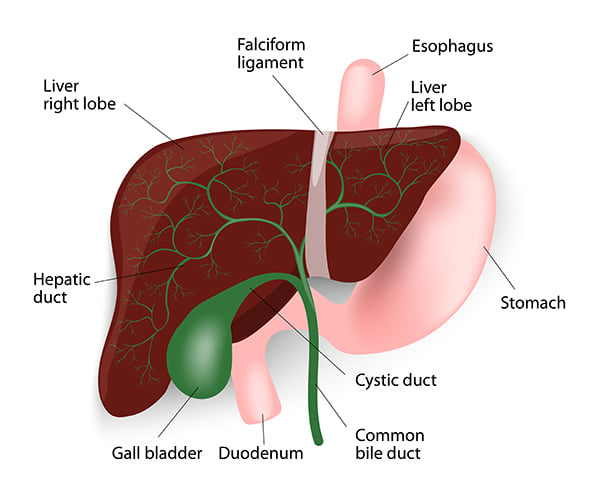
- Perihilar bile duct cancer: This cancer occurs where the right and left bile ducts leave the liver and merge to form the common hepatic duct. It is known as perihilar bile duct cancer, perihilar cholangiocarcinoma, or Klatskin tumor.
- Distal bile duct cancer: This cancer develops where the ducts from the liver and gallbladder unite to form the common bile duct. The common bile duct runs through the pancreas and opens into the small intestine. Distal bile duct cancer is also referred to as extrahepatic cholangiocarcinoma.
Risk Factors
Several factors may contribute to a higher risk of cholangiocarcinoma, including:
- Primary sclerosing cholangitis – This disorder results in the bile ducts becoming stiff and scarred.
- Chronic liver disease – Having a history of chronic liver disease can lead to liver scarring, which raises the risk of cholangiocarcinoma.
- Bile duct problems present at birth – Individuals born with a choledochal cyst, which leads to enlarged and irregular bile ducts, have a higher risk of developing cholangiocarcinoma.
- A liver parasite – In parts of Southeast Asia, cholangiocarcinoma is linked to liver fluke infections. This occurs from eating raw or undercooked fish.
- Older age – Adults over age 50 often have cholangiocarcinoma.
- Smoking – An increased risk of cholangiocarcinoma is caused by smoking.
- Diabetes – Type 1 or 2 diabetes patients may have an increased risk of cholangiocarcinoma.
- Certain inherited conditions – Certain DNA changes passed on from parents to children could cause conditions that increase the risk of cholangiocarcinoma. Some examples of these conditions are cystic fibrosis and Lynch syndrome.
Prevention
While there is no way to prevent bile duct cancer, you can reduce your risk by protecting your liver (and bile ducts) from inflammation. To do this, you can:
- Protecting yourself from viruses such as hepatitis B, hepatitis C and HIV.
- Reduce your alcohol consumption.
- Chronic liver disease raises the risk of cholangiocarcinoma. While some causes of liver disease are unavoidable, others can be prevented. Take steps to protect your liver whenever possible.
- Maintain a healthy body weight.
- Quit smoking.
Diagnosis
For a diagnosis of bile duct cancer, your doctor may ask for:
- Liver function tests
- Tumor marker tests
- Imaging scans/ tests
- Endoscopic Diagnosis
- Percutaneous Radiological Diagnosis: Percutaneous transhepatic cholangiography (PTC) is a procedure that can be used to view bile duct blockages related to cholangiocarcinoma and drain the blockage.
If the tests point to cancer, your doctor will carry out a biopsy to verify the diagnosis. Bile duct cancer is frequently diagnosed at a late stage since many patients show no noticeable signs or symptoms. Imaging techniques like ultrasound, CT scans, or MRI can detect the tumor, pinpoint its location, and check whether it has spread to other organs.
Treatment
Cholangiocarcinoma treatment depends on where it’s located and if it has spread. Bile duct cancers that haven’t spread can be treated by surgery. But most bile duct cancers have spread by the time they are diagnosed. Cholangiocarcinoma treatment may include:
- Surgery: Removing all or part of your bile duct or affected organs.
- Liver transplant: Replaces your liver with a donor liver.
- Radiation therapy: Radiation is used to kill cancer cells or shrink tumors.
- Chemotherapy (chemo): Drugs are used to kill cancer cells or shrink tumors.
- Targeted therapy: Zeroes in on specific proteins on cancer cells. Targeted therapies block the abnormal proteins that fuel cancer growth.
- Immunotherapy: Helps your body’s immune system fight cancer.
Frequently Asked Questions
1. What is the survival rate for cholangiocarcinoma?
The survival rate for cholangiocarcinoma (bile duct cancer) is generally poor, with a low five-year survival rate, especially when the cancer has spread. Most patients are diagnosed at a late stage, which contributes to the poor prognosis.
2. How to treat bile duct blockage?
Bile duct blockage, also known as biliary obstruction, is usually treated by relieving the blockage and addressing the underlying cause. Treatment may involve endoscopic procedures, surgery, or a combination of both, and may include addressing infections or other complications.