 Health
  Find a
  Book an
 Coronary Artery Disease: Causes, Symptoms, Diagnosis, and Treatment
October 9, 2025
The heart is a strong muscular organ that depends on a constant supply of oxygen to work efficiently. Oxygen-rich blood reaches the heart through three main arteries, which divide into a network of smaller vessels.
Coronary Artery Disease (Ischemic Heart Disease) affects the arteries located on the heart’s surface that deliver oxygen- and nutrient-rich blood to the heart muscle.
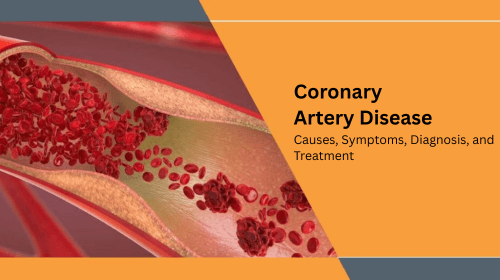
With ageing and other contributing factors, the normally soft and flexible blood vessels begin to harden. Over time, fat, cholesterol, and minerals from the blood accumulate on the inner walls of the coronary arteries, forming plaque. This buildup can restrict blood flow through the arteries. The plaque also makes the artery’s surface rough, which may trigger the formation of a blood clot. Such clots can gradually narrow the artery further or, in some cases, form suddenly and completely block blood flow.
Causes
Coronary Artery Disease (CAD) primarily develops due to atherosclerosis a condition in which plaque gradually accumulates within the arteries. Plaque is made of cholesterol, fat, calcium, and other substances. Over time, it sticks to the walls of the arteries, making them stiff and narrow. This buildup can decrease or obstruct blood flow to the heart.
Sometimes, plaque can rupture, causing blood cells called platelets to form a clot. This can completely block blood flow and lead to a heart attack. Even small plaques that rupture can cause serious problems.
Several factors contribute to the development of CAD:
- High blood cholesterol and fats – Plaque forms from cholesterol and other substances in the blood.
- High blood pressure – Increases stress on artery walls, contributing to atherosclerosis.
- Diabetes or insulin resistance – It can raise the likelihood of plaque accumulation in the arteries.
- Smoking or tobacco use – Damages the blood vessels and accelerates plaque formation.
- Lack of exercise – Contributes to heart problems and plaque buildup.
- Genetics – Family history can increase the risk, though lifestyle factors also play a major role.
Plaque buildup in the coronary arteries can block blood flow, causing chest pain and increasing the risk of a heart attack. Individuals with plaque in their coronary arteries often develop similar buildup in other arteries, which can result in conditions such as peripheral artery disease or carotid artery disease.
Symptoms of Ischemic Heart Disease
- Chest Pain (Angina) – The word ‘angina’ means ‘strangling’. The person may feel pressure or tightness in the chest, which could feel similar to strangulation. This pain or tightness usually occurs on the middle or left side of the chest. Angina is typically brought on by physical exertion or emotional stress. The pain usually goes away within minutes after the stressful activity is stopped. In some people, especially women, the pain may be brief, sharp, and felt in the neck, arm, or back.
- Shortness of breath – Shortness of breath happens when a person cannot get enough air into the lungs. The person could struggle to draw a full breath. It might feel like they have just run a sprint or climbed several flights of stairs.
- Heart attack – A full blockage of a coronary artery can lead to a heart attack. The signs of a heart attack (myocardial infarction) can resemble those of angina. Yet, they are not the same. While angina is caused by a drop in blood supply to the heart, a heart attack happens when there is a sudden lack of blood supply to the heart muscle. This obstruction is typically caused by the accumulation of plaque within the artery. A heart attack is often accompanied by sweating, fatigue, dizziness, nausea, and vomiting.
How is Coronary Artery Disease Diagnosed?
Managing ischemic heart disease starts with consulting a healthcare provider for proper evaluation and care. To determine whether or not a person has ischemic heart disease, the health care provider will ask them to undergo several diagnostic tests.
- Electrocardiogram (ECG) – An electrocardiogram (ECG) measures the electrical activity of the heart as signals pass through it. An ECG can frequently detect signs of a past heart attack or indicate one that is currently occurring.
- Echocardiogram – An echocardiogram employs sound waves to create detailed images of the heart. During an echocardiogram, the doctor can assess whether all areas of the heart wall are functioning properly in pumping blood. Parts of the heart’s function may have been damaged during a heart attack, or parts of the heart might be receiving too little oxygen. This may suggest the presence of coronary artery disease (Ischemic Heart Disease).
- Exercise stress test – If the signs and symptoms occur most often during exercise, doctors may ask the patients to walk on a treadmill or ride a stationary bike during an ECG. Sometimes, an echocardiogram is also done while the patient exercises. This is called a ‘Stress Echo Test’. In some cases, medication could be used to stimulate the heart instead of exercise.
- Nuclear stress test – This test resembles an exercise stress test but includes imaging alongside the ECG recordings. It measures blood flow to the heart muscle at rest and during stress. A tracer is injected into the bloodstream, and special cameras are used to detect areas that are provided with less blood flow.
- Cardiac catheterisation and angiogram – In cardiac catheterisation, a doctor places a thin tube into a blood vessel in the groin, neck, or arm and carefully advances it to the heart. X-ray imaging is used to accurately position the catheter. Sometimes, a contrast dye is introduced through the catheter to enhance the visibility of blood vessels on imaging and reveal any blockages.
- Cardiac CT scan – A computerised tomography (CT) scan of the heart can help the specialist see calcium deposits in the arteries that can limit blood flow. If a significant amount of calcium is discovered, Ischemic heart disease might be probable. In a CT Coronary Angiogram, the patient receives a contrast dye, given intravenously during a CT scan. This allows detailed pictures of the heart arteries to be captured.
Complications
- Heart Attack (Myocardial Infarction): A heart attack takes place when a blood clot stops blood from reaching the heart. Without enough blood, the heart muscle can be damaged or die. Prompt medical care is essential to protect and preserve heart function.
- Angina (Chest Pain): Constricted arteries can decrease the heart’s blood supply, causing discomfort or chest pain. This may happen during physical activity or stress and can worsen over time.
- Heart Failure: Over time, CAD can make the heart weak or stiff. This makes it harder for the heart to pump blood effectively, leading to fatigue, shortness of breath, and fluid buildup.
- Arrhythmias (Irregular Heartbeats): Reduced blood flow can disrupt the heart’s electrical signals, causing irregular or abnormal heart rhythms. Some arrhythmias can be life-threatening.
- Cardiogenic Shock: Extensive heart damage can impair its ability to pump sufficient blood, leading to a critical drop in blood pressure.
- Cardiac Arrest: In serious cases, the heart may stop beating suddenly due to severe arrhythmias or extensive heart damage, which is a medical emergency.
What Can Be Done to Relieve Blockage in the Coronary Arteries?
Plaques that block the coronary arteries usually occur in localised portions of the arteries. The part of the artery beyond the narrowing or closure is often not blocked. When the disease is localised in one or two arteries, the blockage can sometimes be opened by stretching or dilating. This is done by using a small balloon on a tube inside the artery. This procedure is called Angioplasty or PTCA (Percutaneous Transluminal Coronary Angioplasty).
Angioplasty has become a relatively common procedure in recent years. Patients around the world will testify to its success in their lives. That said, it still has a few risks attached.
Your doctor will discuss the risks that specifically relate to your condition.
How is Angioplasty Performed?
Patients who have undergone an Angiogram will find. The angioplasty procedure is almost similar. Angioplasty is also performed in a Cardiac Cath lab; Patients usually receive medication before and during the angioplasty procedure to help them relax. Throughout the procedure, you stay awake and attentive, responding to the doctor’s instructions as needed.
Angioplasty starts with the insertion of a catheter sheath into a blood vessel, usually in the upper leg or groin, and occasionally in the arm.
A very small balloon catheter is passed through the sheath and into the blood vessel leading to the coronary arteries.
With the help of the X-ray, the Cardiologist follows the path of the catheter on the fluoroscope. Pictures may be taken just like in an angiogram.
When the balloon reaches the narrowed section of the artery, it is positioned carefully and then inflated to widen the blockage.
While every situation is unique, inflation in most cases will last from 30 seconds to several minutes, depending on the nature of the blockage. The balloon is inflated at least two times. However, it may also be inflated to ten or more times.
During balloon inflation, some patients may feel chest pain similar to their usual angina. This occurs because the balloon temporarily interrupts blood and oxygen flow to the heart. Any discomfort should be reported to the doctor. Once the blockage is cleared, the balloon is deflated and withdrawn from the blood vessel.
Can Angioplasty be Performed in Other Arteries?
Balloon Angioplasty has expanded the scope of treatment from patients of Coronary Artery Disease to those suffering from blockages in the other arteries of the body. The procedure is being increasingly used to open blockages in the Carotid artery, Renal artery, and other Peripheral arteries.
What is a Stent?
A stent is an expandable mesh tube of a special metal that is designed in a cylindrical wave pattern. The shape and material of the stent offer flexibility for a balloon to adapt to the shape and curves of the artery.
A stent is placed to reinforce the artery and keep it open, acting like a supportive framework. It is placed into your artery immediately after balloon angioplasty and positioned at the blockage site. The implantation of a stent benefits those patients who have a potential for future problems, such as block recurrence or restenosis. The stent remains permanently in the artery once it is implanted.
What is Percutaneous Transluminal Rotational Ablation (PTCRA)?
One of the treatment options for Coronary Artery Stenosis is the PTCRA or Rotablator System, which is used as a stand-alone treatment or in conjunction with PTCA.
The Rotablator system is a catheter-based Angioplasty device utilising a diamond-coated elliptical burr at the tip of a flexible drive shaft. Tracking coaxially over a guide wire and rotating at 190,000 revolutions per minute, the burr preferentially cuts away plaque while avoiding healthy tissue. The burr ablates plaque into fine particles that are disposed of by the body’s reticuloendothelial system.
What Happens After the Angioplasty Procedure?
Following an angioplasty, patients are moved to an Intensive Care Unit for close monitoring. Routine checks of blood pressure, pulse, and ECGs are performed, which are standard and not usually a cause for concern. Suppose a patient experiences any chest discomfort or pressure. The nurse should be notified immediately.
Recovery in the hospital is most likely a matter of allowing the insertion site to heal before getting up and walking around. For the first six to eight hours, most patients need to keep the treated leg or arm straight and still. You may be required to stay in the Hospital for 3-5 days before being discharged to the care of your family doctor. You can return to normal activities a few days after coming home.
Angioplasty is a treatment that helps manage the effects of Coronary Artery Disease, but does not cure it. Strictly following your prescribed medications is crucial, and adopting healthy lifestyle changes is essential for faster recovery and reducing the impact of heart disease. Several factors are known to contribute to the buildup of plaque in the coronary arteries. It is the combination of several of these risk factors, rather than a single factor, that impacts coronary artery disease.
Some of these risk factors such as male sex, age and heredity can only be attended but cannot be changed. However, other factors that can be controlled include:
- High Blood Pressure
- Smoking
- High Blood Cholesterol
- Body Weight
- Diabetes
- Lack of Proper Exercise
- Stress
What Can a Patient Do to Manage Ischemic Heart Disease?
- Keeping the blood pressure, cholesterol, and blood sugar levels in check
- Cutting back on alcohol
- Quitting the use of tobacco products
- Managing the stress
- Practising regular physical activity
Coronary heart disease (Ischemic Heart Disease) cannot be completely cured, but treatment can control symptoms and lower the risk of serious events like a heart attack.