 Health
  Find a
  Book an
 Cerebral Angiography (Brain Angiogram): Procedure, Risks & Recovery
September 1, 2025
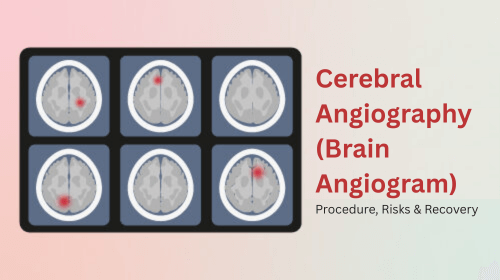
Angiography creates X-ray images of the interiors of blood vessels. Strokes may occur when blood arteries are clogged, constricted, damaged, or otherwise abnormal. Angiography allows a doctor to discover blockages or any other abnormalities in the blood arteries surrounding your head and neck. Cerebral angiography is also referred to as a brain angiogram.
Your doctor would inject contrast material into your blood for the angiography brain test. This contrast substance aids the X-ray in providing an image of your blood vessels. Your doctor can determine if there are any blockages or abnormalities once the image has been created.
Benefits of Undergoing this Treatment
In this instance, it is important to keep in mind that not everyone with artery blockage needs to have a brain angiography. This operation is used mostly because, in many cases, the doctors would need additional information to plan the course of treatment.
Cerebral angiography can aid in the diagnosis of the following conditions:
- Aneurysm
- Artery lining tearing
- Brain cancer
- Venous malformation arteries
- Vessels in the blood become inflamed
Your doctor may use cerebral angiography to determine the origin of the following symptoms:
- Headache
- Loss of coordination or balance
- Numbness or weakness
- Speech slurring, dizziness, memory loss, blurred or double vision
- Stroke
How to Prepare for the Test
- Medical checkup: Your provider may do a physical exam and order blood tests to make sure the test is safe for you.
- Share your medical details: Tell your provider about all medicines you take, including over-the-counter drugs and supplements. Inform them if you have bleeding problems, kidney issues, recent illness, or any long-term health condition.
- Report allergies: Let your provider know if you are allergic to contrast dye, iodine, anesthesia, or any medicines.
- Pregnancy and breastfeeding: Inform your provider if you are pregnant, may be pregnant, or breastfeeding. If you are breastfeeding, you may be asked to pump milk before the test and avoid breastfeeding for 24 hours after the procedure.
- Fasting: You may be asked not to eat or drink anything for 4 to 8 hours before the test, especially if sedation or anesthesia is planned.
- Medication instructions: Your provider may ask you to stop certain medicines, such as blood thinners, aspirin, or anti-inflammatory drugs, for a short time. Do not stop any medicine unless your provider tells you to.
- On the day of the test: Wear comfortable clothing, change into a hospital gown, and remove all jewelry.
- Arrange transport: If you receive sedation, have someone ready to drive you home after the test.
What to Expect During the Procedure
- Getting ready: You will change into a hospital gown and lie on an X-ray table. The table may feel hard or cold. A nurse may give you a sedative through an IV line to help you relax. Children may receive general anesthesia.
- Monitoring: Devices will be attached to your body to check your heart rate and blood pressure during the test. Your head will be gently secured with a strap or support to help you stay still.
- Catheter insertion: The doctor will clean and numb the area where the catheter is placed, usually in the groin, leg, or arm. You may feel a brief sting from the numbing medicine and some pressure when the catheter is inserted.
- Guiding the catheter: The doctor will guide the thin tube through the blood vessels to an artery in the neck. You will not feel the catheter moving inside your body.
- Contrast dye injection: The doctor injects a special dye through the catheter to highlight the blood vessels during X-ray imaging. You may feel a warm or flushing sensation in your face or head. This feeling lasts only a few seconds.
- Imaging: The doctor will take several X-ray images as the dye moves through the blood vessels in your brain. You must stay very still and may be asked to hold your breath briefly.
- Ending the procedure: Once the images are taken, the catheter and IV line will be removed. Pressure will be applied to the insertion site to prevent bleeding, and a bandage or closure device will be placed.
Risks
The chance of developing cancer due to X-ray radiation exposure is meager.
- Iodine or contrasting dye allergy is a small yet potential risk, although clinicians are prepared to treat it.
- The contrasting colour causes a temporary decrease in renal function (5 to 7 days). As a result, people with kidney illnesses are not advised to have this operation unless necessary.
- Any minimally invasive operation entails the risk of blood vessel injury, infection, and bleeding or bruising at the site. Given this, the doctors will take the appropriate safety measures.
- The chance of a blood clot forming at the catheter’s tip is minuscule. However, surgery might be necessary to reopen the vessel because it can obstruct the artery.
- A stroke may result if the catheter dislodges plaque from a vascular wall and blocks blood flow to the brain.
- Internal bleeding results from the infrequent occurrence of the catheter puncturing an artery.
- The catheter tip may separate material from the artery’s inner lining. A block in the blood vessel downstream will result from this.
Post-Angiography Period
You will most likely be taken to a recovery area after the cerebral angiography operation, where you will undoubtedly stay for a few hours before going home. After you get home, perform domestic chores. Stop lifting big things, and don’t use too much energy. Make sure you don’t move about a lot during the first week.
If you see any of the following signs, think about contacting your doctor right away:
- Unsteady speech
- Deficiencies in strength, numbness, or vision
Early indications of a stroke include the symptoms indicated above. Therefore, be careful not to underestimate the circumstances. Watch out for the indicators listed below as well:
- Swelling and redness where the catheter was inserted
- Swelling in the leg
- The foot feels chilly
- Chest pain
- Dizziness
Your doctor would choose the next course of action for you based on whether or not these symptoms are present.
Home Care
When you go home, look for bleeding at the injection site. It’s usual to have a little bruise and the occasional blood drop at the wound.
If the arm or groin was utilised, you should keep an eye on the affected leg to look for any changes in temperature or colour, pain, numbness, or loss of function.
Drink a lot of liquids to flush away the contrast dye and avoid dehydration.
After the treatment, you might be recommended to engage in vigorous activity or take a hot bath or shower.
Relief
Depending on the injection site, you might need to lay flat on a bed for several hours following the surgery, depending on the injection site. But, again, to reduce discomfort and swelling during that period.
When Should You Call Your Doctor?
It’s common to experience minor bruising or light bleeding at the injection site. However, keep an eye out for any changes in temperature, discoloured skin, discomfort, numbness, or loss of function in the limbs close to the injection site. If you experience any of these symptoms, reach out to your doctor.
Frequently Asked Questions
1. How long does it take to recover from a cerebral angiography?
The healing process could take up to 12 to 24 hours, depending on where the contrast dye injection was made. If required, you should be prepared to stay the night. Before the surgery, your healthcare professional can ask for a blood test to determine how quickly your blood clots.
2. What are the side effects of cerebral angiography?
Cerebral angiography is generally safe, but potential side effects include bleeding or bruising at the catheter site, infection, allergic reactions to contrast dye, and, in rare cases, stroke or blood clots. Other risks include kidney damage (especially in those with pre-existing conditions), numbness, weakness, vision or speech changes, and chest pain or breathing difficulty, any of which require immediate medical attention.