 Health
  Find a
  Book an
 Throat Cancer: Symptoms, Causes, Diagnosis, and Treatment
July 9, 2025
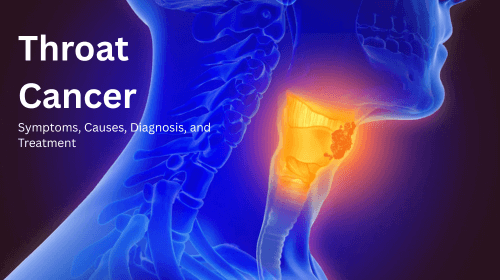
The fact that so many disorders have similar symptoms is one of the problems in medicine. A mild cough or sore throat usually isn’t a major cause for concern, as these symptoms often resolve on their own without treatment. However, occasionally, there are signs of a more severe condition, such as throat cancer. The structures that allow you to swallow, speak, and breathe are where throat malignancies develop.
The throat itself, the tube that begins behind your nose and finishes in your neck, is where about half of these malignancies develop. It’s also known as the “pharynx,” while the remaining cases begin in the “larynx,” commonly referred to as the voice box. These diseases often progress rapidly, so early treatment offers the best chance of recovery and preserving a good quality of life.
Symptoms
You might have:
- Changes in the voice, including hoarseness, voice cracking, or trouble speaking clearly
- Breathing or swallowing issues.
- Having the sensation that something is in your throat
- Persistent ear pain, coughing up blood, or a chronic sore throat
- Headache
- Having neck or ear pain
- A neck lump or persistent pain
- Unaccounted-for weight loss
- Jaw stiffness
- Loose teeth
- Bad breath
- Bleeding in your mouth or throat
- An ulcer that doesn’t heal, or a change in voice
If any symptoms persist for more than a few weeks, make an appointment with your doctor immediately.
However, bear in mind that numerous illnesses that aren’t cancer share identical symptoms.
First Signs
Throat cancer symptoms often go unnoticed in the early stages, as the disease may not cause immediate discomfort. However, as the condition progresses, certain warning signs may become apparent. The first symptoms can vary depending on the specific area of the throat affected.
For instance, individuals with oropharyngeal cancer may experience a persistent lump in the neck, difficulty swallowing, or unexplained ear pain. On the other hand, laryngeal cancer commonly presents as persistent hoarseness or voice changes that do not improve over time.
It’s important to take these symptoms seriously, especially if they last longer than two weeks. Early medical evaluation improves the chances of accurate diagnosis and successful treatment.
Causes
Throat cancer develops when genetic changes occur in the cells of the throat, leading to abnormal and uncontrolled growth. These mutated cells grow quickly, forming tumors that may invade nearby tissues if not treated promptly.
Although the exact cause of these genetic mutations is not always clear, researchers believe that certain risk factors may contribute to their development. Understanding these potential triggers can help individuals take preventive measures to reduce their risk of throat cancer.
Risk Factors
Throat cancer can develop when certain genes in the cells of your throat undergo mutations. While the exact cause of this change is unclear, several factors may increase the risk:
- Smoking cigarettes for a long time – The most prominent risk factors for all head and neck cancers, including throat cancer, are smoking and chewing tobacco.
- Drinking often entails consuming more than two drinks of alcohol per day for men and more than one drink per day for women. In addition, if you smoke and drink, your risk is increased even more.
- HPV – Tongue and tonsil cancers are among the cancers of the back of the throat associated with the human papillomavirus.
Other risk factors are:
- Gender – Men are five times more likely than women to contract it.
- Age – Most diagnoses occur beyond age 65.
- Race – Men of African American descent are most in danger.
- Chemotherapy exposure includes being near nickel, sulfuric acid, and asbestos vapors.
- Inadequate consumption of fruits and vegetables
Types
Most kinds develop in the thin, flat cells surrounding the voice box and throat.
There are two primary varieties of throat cancer:
- Pharyngeal Cancer – Your nose and esophagus are connected by a tube called your throat (pharynx). Food travels through your esophagus from the back of your throat to your abdomen.
- Laryngeal Cancer – The vocal cords are housed in the voice box (larynx), which sits at the lower part of your throat.
Doctors further segment these groups by identifying them geographically. You could develop pharyngeal carcinoma if you:
- Nasopharynx – Behind your nose is the upper portion of your throat.
- Oropharynx – This region lies just behind the mouth, where cancer often affects the soft palate, tonsils, and the back portion of the tongue.
- Hypopharynx – The tiny space beneath your voice box is there.
The vocal cord itself has three areas where cancer can spread. First, you could develop laryngeal carcinoma if you:
- Second, the glottis. This supports the voice cords.
- Second, supraglottis. This is the region above the glottis.
- Subglottis. This is the region that is above your windpipe and below your vocal cords.
Diagnosis
During your physical examination, your doctor will inquire about your sexual history, smoking and drinking habits, and overall health. They might employ equipment to acquire a better view of your neck. Based on the type of cancer your doctor suspects, they will recommend specific tests and treatment options. A biopsy is performed by collecting a tissue sample, which is then studied under a microscope to identify any cancerous cells. It is the sole means of identifying a tumor’s type and determining if it is cancer. Treatment may involve surgery, fine needles, or an endoscope—a flexible tube with a camera inserted through the nose or mouth into the esophagus. The biopsy will be taken with an instrument at the end.
Doctors can use imaging scans to discover tumors. They can also demonstrate its size and whether it has spread. These consist of:
CT or MRI scan
X-rays for PET scans
If oropharyngeal cancer is discovered, the sample could be examined for HPV. If a person’s illness is determined to be caused by this virus, as opposed to a malignancy brought on by smoking, their prognosis for recovery is typically better.
Stages
There are specific guidelines for staging, which identify the severity of the disease for each kind of cancer.
Stages I and II malignancies, however, typically affect a lesser portion of the organ and remain localized.
Diseases in stage III can spread to the throat’s lymph nodes or other areas.
Stage IV tumors may also have spread to the lymph nodes, as well as to areas such as the head, neck, or chest. Finally, stage IV tumors, which are the most dangerous, have spread to distant organs like the lungs or liver.
Examination
To examine the throat, the doctor might wish to do an endoscopy. An endoscope with a camera is inserted into the patient’s mouth. The doctor can see the camera’s output on a display device after it has been enlarged. This makes it easier to see clearly and makes it easier to detect abnormalities. The physician may also employ a laryngoscope to check the larynx. If anything worrisome is found, a biopsy could be performed immediately, in which a few cells are taken and transferred to the lab for additional analysis.
Treatments
The tumor will be removed, the cancer will be stopped from growing, and your ability to swallow and talk will be preserved as much as possible.
Your medical care will be based on:
- The cancer stage you possess
- Its location
- Your general well-being
- what you prefer
One or more treatments could be given to you.
- Radiation Therapy – Radiation therapy targets and eliminates cancer cells using powerful energy beams, applied either from an external device or through internal radioactive implants placed close to the tumor. For early-stage malignancies, radiation therapy may be the sole necessary treatment. However, it can be used with chemotherapy or surgery to treat advanced diseases.
- Surgery -A scalpel can be used to make incisions for surgical procedures. Using lasers, robotics, or an endoscope to enter through the mouth could all be less invasive alternatives. Lasers or endoscopes can typically remove very early malignancies. Your larynx or pharynx may need to be removed entirely or partly, depending on how far along your cancer is. This may impact your capacity to breathe, swallow, or speak normally.
- Doctors may reconstruct a portion of your throat to aid with swallowing using tissue from another region of your body. If your voice box is removed, the surgeon will connect your windpipe to a stoma, a neck opening, so you can breathe. Additionally, if the cancer has penetrated deep into your neck, the surgeon may need to remove affected lymph nodes through a surgical procedure.
- Chemotherapy – Drugs used in chemotherapy can treat cancer and inhibit it from spreading. It can be taken before or after surgery to reduce tumor size and prevent the disease from returning. In addition, certain chemotherapy medications can improve radiation.
- Targeted Therapy – By preventing the nutrients that cancer cells need to develop, targeted treatment medications can starve cancer cells.
Prevention
Individuals who use tobacco are at a greater risk of developing throat cancer. Nonsmokers, however, can also get it in some circumstances. Therefore, it’s imperative to stop smoking.
The following are the negative effects of smoking:
- Decreases the efficacy of the treatment being given.
- It has an impact on the body’s healing process.
- Increases the risk of other malignancies as well.
- Smoking and alcohol consumption greatly elevate the risk of developing throat cancer. Therefore, it’s advisable to cease drinking alcohol because it contributes independently.
- People are urged to use the professional assistance that is constantly available to individuals who want to quit drinking or smoking.
- It is imperative to emphasize the value of a diet high in fiber.
- It is advised to have frequent HPV screenings.
Conclusion
Early awareness and proactive health monitoring are key to improving outcomes for throat cancer. Being aware of possible risks and consulting a doctor promptly enables individuals to manage their health better and improves the likelihood of successful treatment.