 Health
  Find a
  Book an
 Pigeon Toes (In-Toeing): Causes, Symptoms, and Treatment
October 6, 2025
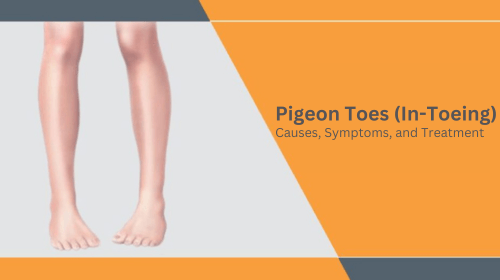
Pigeon toes, also known as in-toeing, occur when a child’s feet point inward rather than straight ahead while walking or running. In most toddlers, this condition is painless and often normal. In-toeing can result from inward rotation of the toes, the shin bone, or the thigh bone. Typically, it improves as children grow, and most kids with in-toeing can walk, run, and participate in sports just like their peers with straight feet.
Types and Causes
In-toeing usually happens because the bones in the leg turn inward. This is normal in most toddlers. In-toeing can occur when any of three parts of the leg rotate inward: the thighbone (femur), the shin bone (tibia), or the foot. This tendency can also be hereditary.
Twisted Thighbone (Femoral Anteversion): This is when the thighbone (femur) has a twist and turns inward. The hip can rotate inward more than usual. Many kids with femoral anteversion can sit in a “W” position. In almost all children, the femur bone will gradually correct and untwist by itself. This tends to happen during elementary school and takes place over many years. There are no braces, shoes, exercises, or chiropractic manipulations that will make this happen faster.
Twisted Shin Bone (Tibial Torsion) – This is when the shin bone (tibia) has a twist and turns inward. Many times, this is because the leg is rotated inward for the baby’s legs to fit in the mother’s womb during pregnancy. In almost all children, the tibia bone will gradually correct and untwist by itself, but this also can take years.
Curved Foot (Metatarsus Adductus) – This is when the foot is curved inward. This can look a little bit like a mild clubfoot deformity, but metatarsus adductus is very different from clubfoot.
Again, this usually corrects on its own after birth, but if the foot does not improve during the first year of life, braces or casts may be recommended.
Rare Causes of Pigeon Toes
In some cases, pigeon toes may be linked to more complex medical conditions, including:
- Cerebral palsy
- Clubfoot (talipes equinovarus)
- Developmental hip abnormalities
- Skewfoot and other rare foot malformations
Pigeon Toes in Adults
While pigeon toes often correct themselves with growth, some adults may continue to have intoeing due to:
- Metatarsus adductus – toes remain inward-pointing, giving the foot a “C” shape
- Femoral anteversion – Internal rotation of the thigh bone at the hip joint
Symptoms
Most children with in-toeing have no pain or functional problems. Often, parents observe their child standing, walking, or running with feet that turn inward. Sometimes it will be noted that children who are into it are clumsy and trip frequently.
Examination
The doctor will review your child’s full medical history, focusing on birth details and developmental milestones. Any pain or limping should be shared. During the physical exam, the doctor will observe your child walking and running and assess the range of motion in the hips, knees, ankles, and feet.
Additionally, a neurological examination will evaluate muscle tightness, nerve and muscle function, and coordination. The doctor will evaluate your child to identify if the inward turning is due to femoral anteversion, tibial torsion, or metatarsus adductus.
Other Studies
The vast majority of children with in-toeing only need to be evaluated with a full history and physical exam. If there is a developmental delay, limp, pain, asymmetry, or a worsening gait, other tests like X-rays may be needed.
Treatment
Normal in-toeing in a toddler requires no treatment other than observation. It can take many years for the bones to untwist as the child grows. Special shoes, braces, or chiropractic manipulation do not make the intoeing improve any faster.
If the femoral anteversion or tibial torsion remains during middle school and causes problems with tripping or walking, surgery may be considered to cut and rotate the bone. This is very rarely needed in otherwise normal children who have femoral anteversion/ tibial torsion.
In-toeing due to femoral anteversion, tibial torsion, or metatarsus adductus tends to improve as children grow. There is a small subset of patients where the in-toeing does not resolve; however, most of these patients have no pain or functional problems.
Frequently Asked Questions
1. Will my child’s walking improve?
For most children, the twist in the leg bones gradually untwists as they grow. Their muscle control and balance also improve with age. Normal in-toeing and out-toeing usually get better with time, but it can take a while to notice progress, like watching grass grow! It might help to record a video of your child walking once a year to track the gradual improvement.
2. My parents think our paediatrician should have used braces to correct my child’s in-toeing/out-toeing, but the doctor said it wasn’t necessary. Who’s right?
In the past, doctors used special shoes, braces, and cables to correct in-toeing/out-toeing. However, studies now show that it improves on its own, and these interventions didn’t speed up the process.
3. When should I take my child to a doctor for in-toeing / out-toeing?
Your child should see a doctor if in-toeing/out-toeing doesn’t improve by kindergarten, if there’s pain, limping, developmental delays, or worsening walking. Out-toeing in one foot in teenagers is concerning, especially if there’s hip, thigh, or knee pain. In such cases, your child should be evaluated with X-rays right away.
4. My toddler trips frequently due to in-toeing. When should I be worried?
Many toddlers who have in-toeing also trip. Remember, toddlers are still learning to walk and lack the muscle control, balance, and coordination for their busy lives. In-toeing can make tripping seem worse, but as your child becomes stronger and more coordinated, the tripping will improve.