
 Health
  Find a
  Book an
 Ankle Injury: Causes, Types, Symptoms, and Treatment
September 23, 2025
An ankle injury is often thought of as a sports injury. However, even if you’re not someone who engages in regular physical activity, you can still injure your ankle. Something as simple as walking on uneven ground can cause a painful, debilitating sprain.
Ankle injuries can occur at any age. However, men aged 15 to 24 have a higher incidence of ankle sprains than women over 30, who have a higher rate than men. Half of all ankle sprains occur during exercise. The most frequent ankle injuries are sprains and fractures, affecting the ligaments and bones. Tendons can also be torn or strained.
Kinds of Ankle Injuries
A fracture is a break occurring in one or more bones. A sprain describes damage to the ligaments when stretched beyond their normal range of motion. Ligament sprains can range from many microscopic tears in the fibres that make up the ligament to a complete rupture or tear. A strain occurs when a muscle or tendon is overstretched or overexerted, causing tissue damage.
A sudden force or trauma can cause tendon injuries. In the ankle, two tendons can often be strained. These are the peroneal tendons; they stabilize and protect the ankle. They can become inflamed if used excessively or if there is trauma involved. Inflammation of the tendon is called tendinitis. Microscopic tendon tears that build up over time due to frequent overstretching and not healing properly lead to tendonitis. Tendons can also rupture, which can be a serious injury. Subluxation occurs when a tendon partially moves out of its usual position.
Causes
An ankle injury can be caused by many different things, including running, falling, or being hit by a football or soccer ball. An ankle injury happens when the joint is forced or rotated beyond its normal range of motion. Most ankle injuries occur during sports activities or on uneven surfaces that push the foot and ankle into an abnormal position. For example, walking in high heels, clogs, or sandals that are too loose can cause ankle injuries. An ankle injury can also occur as a result of wearing faulty footwear.
- Tripping or falling
- Landing awkwardly after a jump
- Walking or running on uneven surfaces
- Twisting or rotating the ankle
- Rolling the ankle
Types of Ankle Sprains
Ankle sprains can be categorized into three levels according to how much the ligaments are injured:
- Grade 1 (Mild): The ligament fibres stretched slightly, or there was a tiny tear. Your ankle will have a little swelling and tenderness to the touch.
- Grade 2 (Moderate): The ligament is damaged but remains partially intact, not fully torn. The ankle may show mild swelling and be tender when touched.
- Grade 3 (Severe): The ligament has been fully ruptured. Your ankle will swell significantly, the injury is painful, and walking is difficult.
Symptoms of a Sprained Ankle
Typical symptoms of a sprained ankle include pain, swelling, and reduced range of motion.
Symptoms of a sprained ankle are:
Discomfort that intensifies when bearing weight on the affected ankle, along with sensitivity to touch. Tenderness to touch. Some swelling may occur as a result of the injury. Bruising can happen when the skin is injured. Difficulty while walking.
What Should Someone Do After an Ankle Injury?
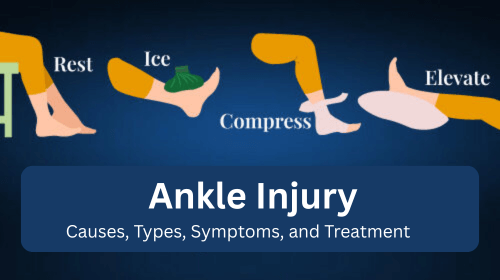
Apply first aid for an ankle injury. You should rest the ankle, ice it, and compress the ankle with a bandage or a cloth. (RICE method).
- Rest: Stay still and rest the injured area as much as possible. Some experts recommend a period of no weight-bearing activities lasting 24 to 48 hours. Continued use of a moderately or severely sprained ankle may delay healing, increase pain, or exacerbate the injury. Most people can resume regular activity after resting for 24 to 48 hours with a mild sprain.
- Ice: Using ice can decrease inflammation and provide a soothing, numbing effect to relieve pain. To ice appropriately, you should ice within 48 hours of an injury, and never leave ice on for longer than 20 minutes to prevent frostbite. Wait for 40 to 45 minutes before reapplying ice to allow tissues to return to normal temperature and sensation, and repeat as needed.
- Compress: Wrap the injured ankle with an elastic bandage or compression wrap to keep it immobilized and supported. Be careful not to over-tighten your ankles. If your toes turn blue, get cold, or feel numb, the wrap is too tight.
- Elevate: Raising the injured ankle to or above heart level helps minimize swelling and alleviate pain.
How to Reduce the Risk of an Ankle Injury?
There are ways to reduce your risk of spraining your ankle. Some tips include wearing supportive shoes, keeping your ankle stable when walking, and avoiding sudden movements. To prevent ankle sprains, you should exercise regularly to maintain muscle strength before starting an exercise or physical activity, warm up, and stretch. Pay attention to uneven surfaces you walk or run on. If you feel tired during activity or exercise, slow down or stop.
How is a Sprained Ankle Diagnosed?
Your healthcare provider will examine your foot and ankle to determine your range of motion and which ligaments are affected. Based on this information, they will then make a diagnosis of a sprained ankle. The physical exam typically includes an imaging test, like an X-ray.
Frequently Asked Questions
1. What are the different types of ankle injuries?
An ankle injury is typically classified as either a ligament or a bone injury. Tendonitis, muscle strain or tear, and ankle sprain are all types of ligament injury. Fractures are a type of bone injury. Treatment varies according to tissue.
2. How do you know if an ankle injury is serious?
People with more severe ankle sprains, characterized by extreme bruising or swelling and the inability to walk with weight without significant pain, should seek medical attention if there seems to be no improvement in the first few days after the injury.
3. What does a torn ligament in your ankle feel like?
If you have a broken or fractured ankle, you will likely experience severe pain, swelling, bruising, and deformity in the area. You may not be able to place any weight on the injured leg. The symptoms of a torn ligament are similar and include immediate pain, inflammation, and bruising.
4. What is the typical recovery time for a sprained ankle?
Healing duration for a sprained ankle depends on how severe the injury is. It can take two weeks to cure a mild sprain and 6-12 weeks to cure a severe sprain.